Thursday, March 25, 2010

Legal Version Of Age Of Empires Full

leaves

Leaves are lateral appendages of the trunk and its branches. They are often green in them because they contain a lot of chlorophyll, a pigment needed by plants for photosynthesis, which allows them to "breathe." The leaves are also the site of gas exchange with the external environment.
There are many types of leaves, even if we know the most nomofilli , that the leaves on the branches are seen!
But there are also embriofilli (cotyledons) that are inside the seeds (if only monocots, dicots if there are two), the catafilli found in barrels in the ground, the ipsofilli (bratee) of flowers, the whole fruit (sepals and petals of flowers), the sporofilli (leaves carrying spores, which are necessary for reproduction).

leaf as it classical, is characterized by a sheet, a petiole and stipules, which are short appendages at the base of the stalk. The foil is the green (or color) of the leaf. Some leaves are even colorless ( plant Aucuba ) or stained for the presence of red pigments called anthocyanins. When the leaf is about to fall to the ground becomes of other colors such as yellow, orange or red, as it moves from leaf chlorophyll, and this is filled with carotenoids. The stem is that part that starts from the branch and arrives at the base of the lamina, a dark color.

The leaves possess ribs, which are those streaks that you see with the naked eye and feel by touching the plate (especially at the bottom of it). Depending on the types of ribs, there is a classification of the leaves:

1) uninervie leaves (only one rib, such as conifers, pine for example);
2) parallelinervie leaves (veins almost parallel to each other, such as maize);
3) penninervie leaves (a the leaf midrib divides into two almost equal parts, the common characteristic of the leaves, such as the apple);
4) palminervie leaves (the leaf is shaped like the palm of your hand and slide the ribs in each "finger ", as the screw);
5) leaves peltinervie (ribs start from the center of the leaf to go in all directions, like spokes of a wheel).

There are also free leaf veins, such as those of Gingko Biloba , leaves very old and unique in the world, with grooves parallel to each other and particular shape.
Other classifications grouped in pinnate leaves (a pen), palmate (shaped like the palm of your hand), and peltate.

The deciduous are those who fall each end of the growing season (every season), while the persistent leaves are evergreen plants and last longer than a season.

Each leaf may also have margins of , which are divided into whole, serrated, toothed, crenate, wavy, lobed, parties.

For a detailed classification and precise you can refer to this page .


apple leaf

grape leaf


peltinervia leaf (water lilies)

leaf pine

gingko biloba leaf

corn leaf


examples of leaf margins

NOTE: All images are taken from the web.

Wednesday, March 24, 2010

Sentiments For Shower Card

Viruses

Viruses are intracellular parasites that obliged to live in need of a living cell. The virus is the Virion , which may contain DNA (deoxyribonucleic acid) or RNA (ribonucleic acid). In this way we can classify the virus DNA or RNA. DNA viruses generally have a double-stranded DNA wrapped around itself, while the RNA has a single RNA molecule. There are also human retrovirus , such as HIV and T-cell leukemia Viruses are also made from Capsid , an envelope protein consists of 5 / 6 units called capsomeres. Among DNA viruses include Herpes Simplex Virus and Zooster, the smallpox virus, papilloma virus, RNA viruses are the influenza, rubella, measles.

Viral infection is manifested by the attachment of the virion to the cell membrane. Following is the penetration, with the insertion of nucleic acid in the host cell nucleus, leading subsequently to cell lysis. Once the DNA is transcribed, the host cell dies and gives way to the virus.

Examples of viruses:

poxvirus - smallpox
Herpes virus - Herpes Simplex, Varicella Zooster, Epstein Barr, Cytomegalovirus
Adenovirus
Parvovirus - Virus rats
Rabdovirus - rabies, vesicular stomatitis
Togavirus - yellow fever, dengue virus
Rubellavirus - rubella
picornaviruses - poliomyelitis and enteric viruses
Leucovirus - cancer, Rous sarcoma, leukemia in rats

Knee Arthroscopy Scar Tissue

's law Gay-Lussac

Gay Lussac was a French-born scientist, who discovered that when two gases react, the relationship between the volumes of reagents and products are always the same as the relationship between whole numbers.

For example, a volume of hydrogen reacts with chlorine giving a volume of two volumes of hydrochloric acid, according to the reaction:

H + Cl → HCl

Again, two volumes of hydrogen react with oxygen to give a volume of two volumes of water, according to the reaction:

H + O2 → H2O


First Law of Gay Lussac : constant pressure, the volume of a gas increases with ' increasing temperature.

V(T)={V}_0 \cdot (1 + \alpha T)\,\!

V0 = volume of gas at a temperature of zero degrees Celsius
V (T) = volume to a temperature greater than zero:
Alpha = expansion coefficient of gas (volume increase immediately by a unit volume gas when its temperature rises 1 ° C).

If the temperature is not taken as a reference in degrees centigrade but in degrees Kelvin, the law becomes:

V(T)={V}_o \cdot {\alpha}\cdot T\,\!


second law Gay Lussac : constant volume the pressure of a gas increases with temperature.

 p(T)={p}_o \cdot (1+{\alpha}\cdot T)\,\!

P0 = pressure of a gas at 0 ° C;
P (T) = pressure at a temperature greater than 0 ° C;
Alpha coefficient of expansion of the gas (relative increase of gas pressure when the temperature rises 1 ° C).

If the temperature is in degrees Kelvin, the law becomes:

p(T)={p}_o \cdot {\alpha}\cdot T\,\!


Both these laws are valid not too high pressures and temperatures close to the liquefaction of gases. It is therefore more occurred when a gas behaves like a perfect (ideal).

My Firend Bang My Wife

The Periodic Table


The Periodic Table of the elements is a tool that is used to classify the most representative inorganic chemical elements, divided into groups (vertical lines) and periods (horizontal lines). The elements are divided into metals, non metals and metalloids (metals).

I metals elements are widespread, malleable, ductile and can be processed to be cut into smaller sheets. Have a high electrical conductivity, high thermal conductivity and are shiny. Among the metals include sodium (Na), beryllium (Be), Magnesium (Mg), aluminum (Al), potassium (K), iron (Fe), cobalt (Co), copper ( Cu), nickel (Ni) and so on.

I non-metals have properties opposite to metals (low electrical and thermal conductivity, low ductility and malleability). These are elements such as hydrogen (H), sulfur (S), phosphorus (P), nitrogen (N), chlorine (Cl), oxygen (O), etc..

I metalloids still have different properties, which are between metals and non-metals. This is the boron (B), Silicon (Si), arsenic (As), tellurium (Te), germanium (Ge).


The elements of the Periodic Table are (in order of atomic number):

a hydrogen (H)
2 Helium (He)
3 Lithium (Li)
4 Beryllium (Be)
5 Boron (B)
6 Carbon (C)
7 Nitrogen (N)
8 Oxygen (O)
9 Fluorine (F)
10 Neo (Ne)
11 Sodium (Na)
12 Magnesium (Mg)
13 Aluminium (Al)
14 Silicon (Si)
15 Phosphorus (P)
16 Sulphur (S)
17 Chlorine (Cl)
Argo 18 (Ar)
19 Potassium (K)
20 Calcium (Ca)
Scandia 21 (SC)
22 Titanium (Ti)
23 vanadium (V)
24 Chromium (Cr)
25 Manganese (Mn)
26 Iron (Fe)
27 Cobalt (Co)
28 Nickel (Ni)
29 Rame (cu)
30 Zinc (Zn)
Gallio 31 (Ga)
32 Germanium (Ge)
33 Arsenic (As)
34 Selenium (Se)
35 Bromo (Br)
36 Cripto (Kr)
37 Rubidio (Rb)
38 Stronzio (Sr)
39 Ittrio (Y)
40 Zirconio (Zr)
41 Niobio (Nb)
42 Molibdeno (Mo)
43 Tecnezio (Tc)
44 Rutenio (Ru)
45 Rodio (Rh)
46 Palladio (Pd)
47 Argento (Ag)
48 Cadmio (Cd)
49 Indio (In)
Stagno 50 (Sn)
51 antimony (Sb)
Tellurio 52 (tea)
Iodi 53 (I)
54 Xeno (Xe)
55 Cesium ( Cs)
56 Barium (Ba)
Kantanio 57 (A)
58 Cerium (Ce)
59 Praseodymium (Pr)
60 Neodymium (Nd)
Promezio 61 (PM)
62 Samaria (Sm)
63 europium (Eu)
64 Gadolinium (Gd)
65 Terbium (Tb)
66 Dysprosium (Dy)
67 Holmium (Ho)
68 erbium (Er)
69 Thulium (Tm)
70 Ytterbium (Yb)
71 Lutetium (Lu)
72 Hafnium (Hf)
73 Tantalum (Ta)
74 Tungsten (W)
75 Rhenium (Re)
76 Osmium (Os)
77 Iridium (Ir)
78 Platinum (Pt)
79 Gold (Au)
80 Mercurio (Hg)
81 Tallio (Tl)
82 Piombo (Pb)
83 Bismuto (Bi)
84 Polonio (Po)
85 Astato (At)
86 Rado (Rn)
87 Francio (Fr)
88 Radio (Ra)
89 Attinio (Ac)
90 Torio (Th)
91 Protoattinio (Pa)
92 Uranio (U)
93 Nettunio (Np)
94 plutonium (Pu)
95 Americium (Am)
Curio 96 (Cm)
97 Berkelium (Bk)
98 Californium (Cf)
99 Einsteinium (Es )
100 Fermium (Fm)
101 Mendelevium (Md)
102 Nobelium (No)
103 Lawrencium (Lw)

Each element of the table periodical has its own atomic number (top left corner), an atomic weight (in the upper right corner), the symbol (in the case Iron Fe for example), the name immediately below the symbol, and the electronic configuration, data from orbit.
The atomic number indicates the number of protons in the atomic nucleus and is indicated with the letter Z. The atomic weight is the mass of an atom of the element, expressed in atomic mass units. The electronic configuration is the arrangement of electrons around the nucleus of an atom (or more nuclei of atoms).

Here you find the table interactive periodic ! We will return very useful in your studies!

Crusing Spots In North Jersey

The surname

The surname is that part of our name which we inherited from birth, an ancient custom dating back to medieval times . Formerly, the name did not exist, but people were identified only by their names. The Romans introduced more names, or even three (praenomen, that is the proper name, the nomen, which identified the immediate family, and ultimately the cognomen). The name of a Roman could be very long, because sometimes you add more names! Over time these customs changed again, and often was called with only a nickname, a personal characteristic signature of the person. With increasing population, the introduction of the name was made necessary in order to better distinguish people from each other. From ' thousand years about the surnames begin to spread, first to the families of the nobility and later the entire population. In 1564, the year of award of Council of Trent , the surname became compulsory and hereditary.
The surname was a characteristic of a person, which could be related to the nature, origin, the family craft and many other things.

There is a very interesting site that allows you, by entering your name, display the presence and distribution of it throughout Italy! Try it, enter your name here
the site you can also order your shirts with your name!


How Does Ur Period Look Like

maps of Italy

Italy, our state, is divided into 20 zones, namely:

Valle d'Aosta
Piedmont
Liguria
Lombardia
Trentino-Alto Adige
Veneto
Friuli-Venezia Giulia
Emilia-Romagna
Tuscany
Marche
Umbria
Lazio
Abruzzo
Molise
Campania
Basilicata
Puglia
Calabria
Sicily
Sardinia

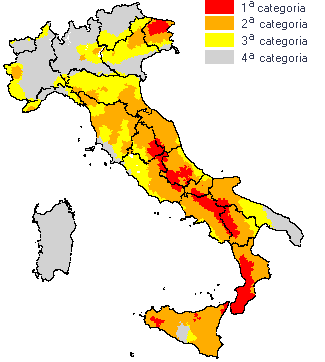
A school is often the case that the teachers make you study the maps. We have a map that divides Italy by region, but also a physical map, a geological map, a map Street, a satellite map, historical maps and even! Below are the main maps of Italy, including a scheme in black and white if you need to follow in Italy with the tracing paper!

Map
policy


Geographic map
Geological Map

Italy seen from the satellite

Map mold that you can use for your designs


This link you can find a geological map to be enlarged, while in this seismic map.